
Your company has decided that Power BI is the right business intelligence platform. The dashboards are promising, the pricing is right, and the Microsoft integration makes sense for your stack. Now comes the harder question: should you implement it yourself, or bring in a consulting partner?
For most mid-market companies, those with 50 to 500 employees, the answer is clear. A Power BI consulting partner does not just build reports faster. They design the data architecture, governance framework, and adoption strategy that determine whether your BI investment delivers lasting value or becomes another underused tool.
This guide covers what Power BI consulting actually includes, how to evaluate partners, what a typical engagement looks like, and what to budget.
Power BI consulting goes well beyond building dashboards. A capable partner covers the full spectrum of work required to turn raw data into reliable, governed, organisation-wide analytics:
If you are still evaluating whether Power BI is the right platform, our Power BI vs Tableau comparison breaks down the key differences for mid-market companies.
Not all consulting partners are equal. These seven questions will help you separate the specialists from the generalists.
Microsoft's partner programme certifies firms that meet competency thresholds in specific solution areas. A certified Microsoft Solutions Partner for Data & AI or Digital & App Innovation has demonstrated real-world delivery capability, not just theoretical knowledge. Find certified partners in the Microsoft Solutions Partner directory.
A consulting partner who has worked with finance teams, manufacturing operations, or professional services firms will understand your reporting patterns, compliance requirements, and KPI structures. Ask for case studies or references in your sector.
This is the question that separates 2024-era consultants from 2026-era partners. Microsoft Fabric is the unified data platform that underpins Power BI at scale. A partner who only knows standalone Power BI cannot help you take advantage of OneLake, lakehouses, data pipelines, or AI workloads, capabilities that most mid-market companies will need within the next 12 to 18 months.
A structured methodology, discovery, architecture, build, test, train, launch, is a sign of maturity. Partners who skip the discovery phase and jump straight into building dashboards are likely to deliver reports that look good but sit on shaky data foundations.
Ask specifically about row-level security, data classification, Microsoft Purview integration, and audit logging. If governance is an afterthought in their process, it will be an afterthought in your implementation.
The goal of any consulting engagement should be to leave your team more capable than before. Partners who build everything behind closed doors and hand over a finished product without training are creating dependency, not value.
Power BI is not a set-and-forget tool. Your data sources change, your business questions evolve, and new features ship quarterly. Ask about support plans, SLAs, and how they handle post-launch requests.
While every engagement is different, most mid-market Power BI implementations follow a predictable structure:
The partner maps your existing data landscape, what systems hold your data, how it flows between them, where the gaps and inconsistencies are, and what questions your leadership team needs answered. This phase also identifies stakeholders, defines success metrics, and sets the project scope.
Based on discovery findings, the partner designs the data model, how your tables relate, what calculations and measures are needed, how data refreshes, and how the semantic layer is structured. For organisations moving to Microsoft Fabric, this phase includes OneLake architecture and pipeline design.
This is where reports and dashboards come to life. A good Power BI consulting company involves business stakeholders in design reviews, not just at the end. Expect iterative cycles: prototype, review, refine. Dashboards should be built on a solid semantic model, not hard-coded with one-off queries. For inspiration on what effective dashboards look like, see our Power BI dashboard examples for finance and operations leaders.
User acceptance testing ensures reports are accurate and performant. Training sessions, typically a mix of admin training for IT and self-service training for business users, ensure adoption. Go-live includes monitoring, bug fixes, and stakeholder sign-off.
Post-launch, the partner provides ongoing support for performance tuning, new report requests, data source additions, and quarterly Power BI feature adoption. The best partners offer tiered support plans that scale with your needs.
Total timeline for a typical mid-market engagement: 6-10 weeks from kickoff to go-live, depending on scope and data complexity.
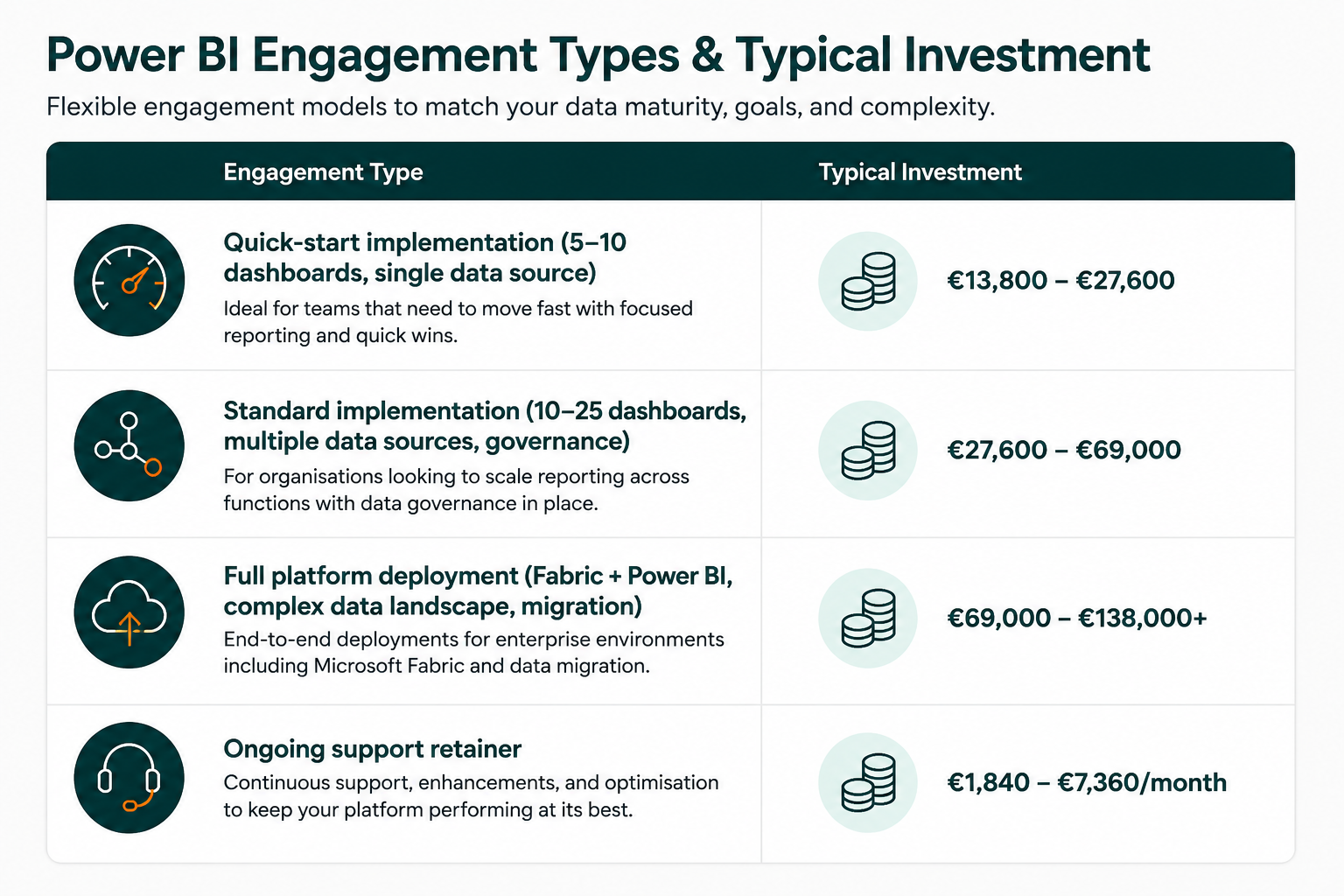
Transparency on cost builds trust, so here are realistic ranges for mid-market Power BI consulting engagements:
Factors that influence cost include:
The ROI framing: A mid-market company spending €46,000 on a Power BI implementation that eliminates 20 hours per week of manual reporting across the finance team recovers that investment in under 6 months, before accounting for better decision-making speed and accuracy.
Avoid Power BI consulting partners who:
For mid-market companies, typical engagements range from €13,800 for a focused quick-start implementation to €138,000 or more for a full Fabric + Power BI platform deployment. Ongoing support retainers typically run €1,840-€7,360 per month.
Most mid-market implementations take 6-10 weeks from kickoff to go-live. Quick-start engagements focused on a small number of dashboards can launch in 3-4 weeks. Complex deployments with data migration and Fabric architecture may take 12-16 weeks.
Yes. Migration from Tableau, SSRS, or other BI tools to Power BI is a common consulting engagement. The process includes report inventory, data source mapping, re-implementation in Power BI, and parallel testing to ensure accuracy before decommissioning legacy tools.
It depends on your data complexity. If your data lives in a few well-structured sources and your needs are primarily dashboards and reports, standalone Power BI may be sufficient. If you have multiple data sources, need data engineering pipelines, want AI capabilities, or are planning to scale analytics across the organisation, Fabric provides the unified platform to support that growth.
Choosing a Power BI consulting partner is a decision that shapes your company's analytics capability for years. DIGMATIX is a certified Microsoft Partner specialising in Power BI and Microsoft Fabric for mid-market companies across the Baltics, Nordics, Poland, and Croatia. Our engagements are designed to deliver value in weeks, not months, and to leave your team empowered to grow.
Learn more about Power BI on Microsoft's Power BI documentation.
Book a free 30-minute consultation to scope your Power BI implementation and get a custom roadmap for your organisation.
---
Related reading:
Would you like to learn more? Let's get in touch.
Sending...