The enterprise resource planning (ERP) landscape is undergoing its most significant transformation since cloud adoption. Artificial intelligence, particularly intelligent copilots, is no longer a futuristic concept—it's reshaping how finance, sales, supply chain, and human resources teams work today. For executive leaders, understanding this shift isn't optional; it's essential to maintaining competitive advantage.
At DIGMATIX, we've guided dozens of organizations through their AI-in-ERP journey. The consistent finding: those who understand the strategic implications and prepare their organizations now are capturing measurable ROI while their competitors scramble to catch up.
This post is designed for C-suite executives and strategic decision-makers. We're not diving into feature checklists—you have product documentation for that. Instead, we're exploring the AI landscape reshaping ERP, what it means for your business, and how to build a roadmap that works.
Understanding AI adoption in ERP requires recognizing that AI doesn't arrive all at once. It evolves in predictable waves, each with different strategic implications.
The first wave is what we're experiencing now. AI-powered copilots act as intelligent assistants within ERP workflows. A finance team member writes an email to a supplier—Copilot drafts a professional response. A sales rep needs a contract summary—Copilot extracts key terms and flags risks. A supply chain planner needs demand forecasts—Copilot analyzes patterns and suggests inventory adjustments.
These are suggestions, not actions. Humans remain in control, reviewing and approving AI outputs. This is where Microsoft's Copilot for Business Central and Dynamics 365 Sales Copilot operate today.
Real ROI from Wave 1:
The competitive advantage here is immediate: 15–20% improvement in team productivity, typically within 90 days of deployment.
The second wave is emerging now. Agentic AI systems don't wait for human initiation—they identify problems and execute multi-step workflows with human oversight.
Instead of a user asking Copilot "suggest a payment schedule," an agentic ERP system notices that a supplier invoice is approaching its due date, evaluates cash flow positions, proposes an optimal payment date that minimizes working capital while maintaining supplier relationships, and flags the action for approval. The human reviews the proposal in seconds rather than minutes, and approves or adjusts it.
This represents a fundamental shift in how ERP systems operate: from human-initiates-AI to AI-initiates-with-human-oversight.
Examples of agentic workflows in development:
This wave requires more mature data foundations and governance structures, but the ROI multiplies. Organizations typically see 25–40% efficiency gains in targeted processes.
The third wave—still emerging—involves AI agents that coordinate across multiple ERP modules and even external systems. An order fulfillment agent might coordinate purchasing, logistics, finance, and customer service simultaneously. A workforce planning agent might align hiring forecasts with demand planning and budget allocation.
This wave requires deep integration, sophisticated governance, and clear accountability structures. We expect to see mainstream adoption by 2027–2028.
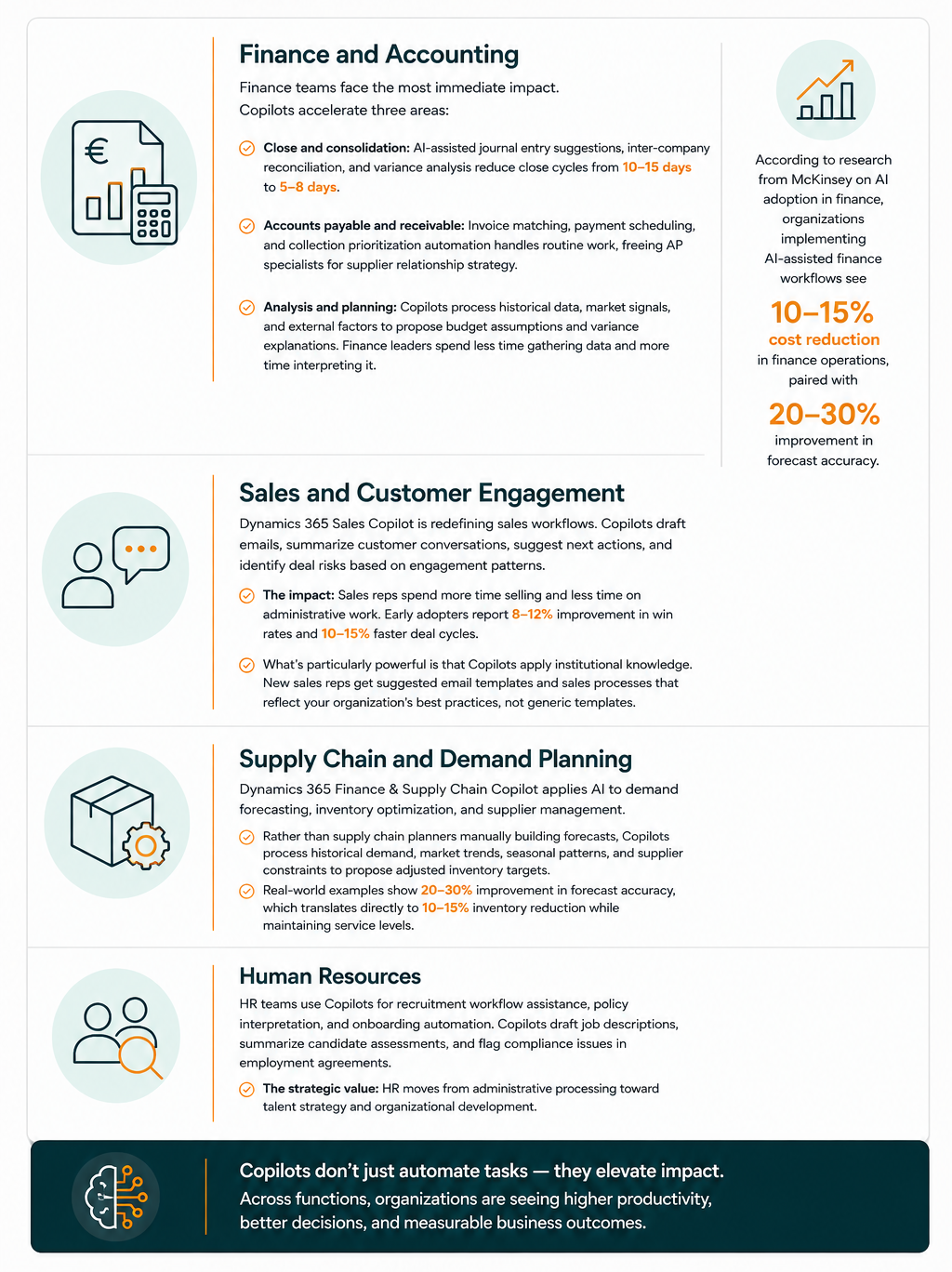
AI in ERP isn't monolithic. Different departments experience different transformations.
The move from assisted AI to agentic AI fundamentally changes how ERP systems initiate work.
Today (Assisted Model):
Tomorrow (Agentic Model):
This shift requires three organizational changes:
First: Better data governance. Agentic systems are only as good as the data they process. "Garbage in, garbage out" applies doubly to AI. Organizations planning for agentic workflows need to invest in master data management, data quality frameworks, and clean transactional data.
Second: Clearer governance and oversight. Who approves AI-initiated actions? What's the audit trail? How do you handle edge cases? Organizations need explicit policies covering human-in-the-loop decisions, audit requirements, and responsible AI principles.
Third: Changed role definitions. Rather than replacing workers, agentic AI frees them from routine work. Finance analysts shift from data gathering to interpretation. Sales reps shift from email drafting to relationship building. Organizations need to invest in training and role evolution.
Theory is interesting, but results matter. Here's what we're seeing in real deployments:
These aren't theoretical—they're documented in post-implementation reviews from DIGMATIX clients.
Here's the uncomfortable truth: AI amplifies existing data problems. If your master data is inconsistent, your invoices lack proper coding, or your product hierarchies are outdated, AI will produce garbage outputs. Conversely, organizations with clean data see dramatically better AI outcomes.
Before implementing Copilot, assess your data readiness:
Organizations that invest 4–6 months in data hygiene before Copilot deployment see 40–50% better AI outcomes than those who skip this step.
AI governance isn't optional—it's how you manage risk and maintain stakeholder trust.
Key governance areas:
Human-in-the-loop decisions: Define which AI actions require human approval. In banking, regulatory requirements may mandate approval for credit decisions. In finance, certain GL posting rules may require CFO visibility before automation.
Audit trails and explainability: Systems must log why an AI system took action, what data it considered, and what alternative actions it evaluated. This is non-negotiable for regulatory compliance.
Bias and fairness monitoring: AI systems can inadvertently perpetuate biases in data. Regular audits ensure that AI-assisted hiring decisions, credit approvals, or pricing recommendations don't discriminate.
Responsible AI principles: Establish organizational standards for AI use. Microsoft's Responsible AI principles (transparency, accountability, fairness, reliability, and privacy) provide a solid framework.
Per Mareks Polis, ERP Practice Lead at DIGMATIX: "The organizations getting the most value from Copilot aren't the ones deploying it fastest. They're the ones building governance structures first. They know where human judgment is essential, and they've designed their AI workflows to protect those checkpoints. That's what separates transformative implementations from problematic ones."
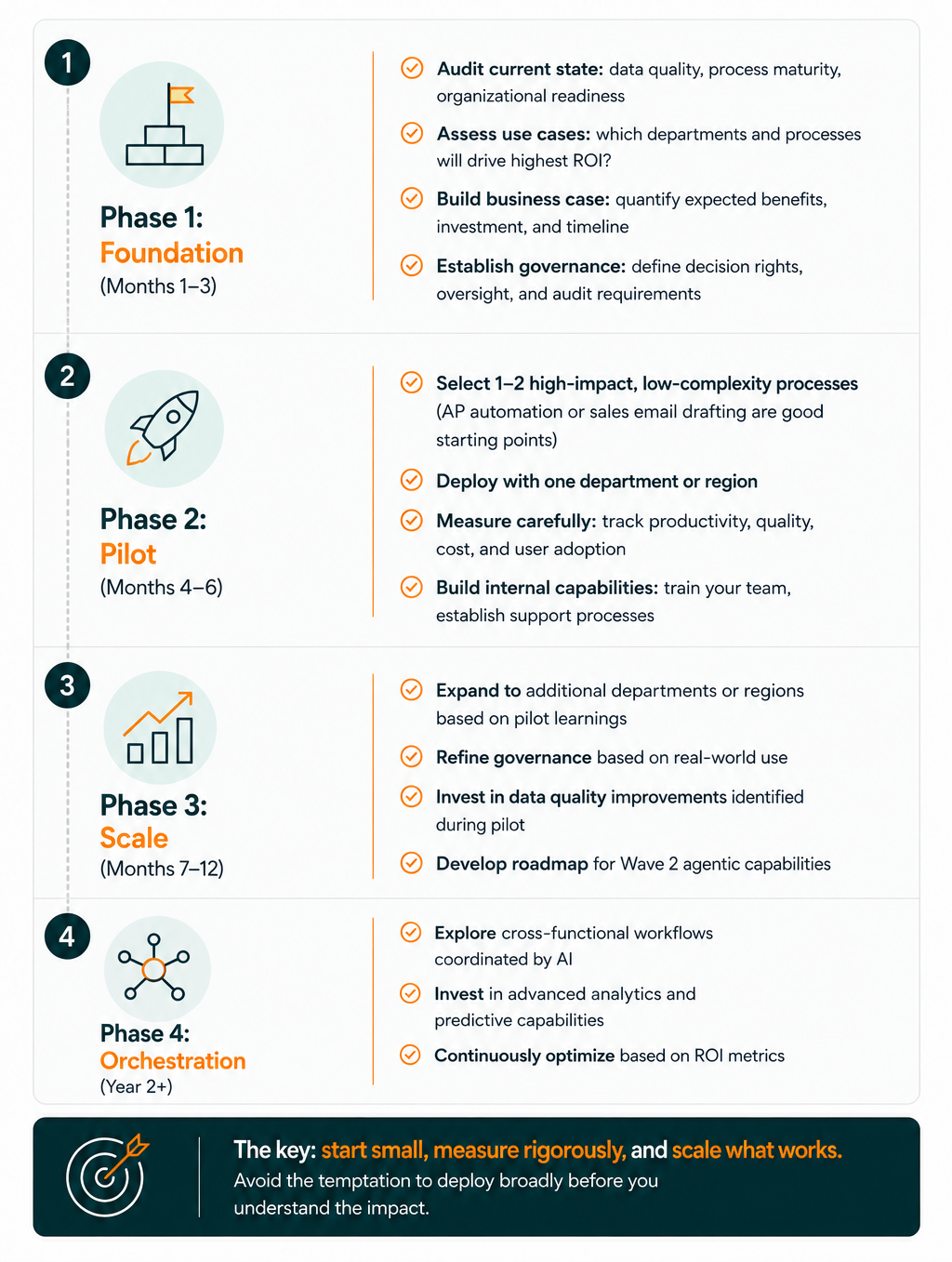
Strategic adoption follows a pattern:
One question we hear repeatedly: Will AI replace our employees?
The honest answer: It will change their roles, not eliminate them. Finance analysts shift from data gathering to analysis. Sales reps shift from email drafting to relationship building. AP specialists shift from invoice matching to supplier management.
This requires investment in training and change management. Organizations that frame AI as augmentation rather than replacement see faster adoption and better outcomes. Employees worry less about job loss and focus on developing skills that AI can't replicate—judgment, relationship building, strategic thinking, and complex problem-solving.
Per Mareks Polis: "The best outcomes we've seen come from organizations that invest equally in technology and people. They're not just deploying Copilot—they're reskilling teams to work alongside it. That's harder than just enabling a feature, but the ROI is exponentially better."
Organizations that move now have several advantages:
First-mover knowledge: You'll understand what works in your industry, what doesn't, and how to measure success. Later adopters will benefit from your experience, but you'll have already captured the learning value.
Data advantage: The more you use AI, the more your systems learn. Organizations that start early will have more mature AI models by the time competitors catch up.
Talent advantage: Early adopters attract talent interested in working with cutting-edge tools. This compounds over time.
Cost structure advantage: Organizations implementing AI-assisted workflows now will have structural cost advantages over competitors who adopt later at scale.
The competitive threat is real. If your competitors implement AI-in-ERP before you do, they'll have productivity, quality, and cost advantages that are difficult to overcome.
A: Early wins appear within 90 days. AP automation, sales email drafting, and demand forecasting assistance deliver measurable productivity improvements in the first quarter. More substantial benefits—process transformation, role evolution, cost structure changes—take 6–12 months. A well-executed implementation targeting high-impact processes should deliver positive ROI within the first year.
A: Copilot in Business Central is purpose-built for common ERP workflows and governance requirements. It's faster to deploy (typically 4–8 weeks), lower risk, and includes Microsoft's responsible AI safeguards. Custom AI solutions offer more flexibility but require significant development time, data science expertise, and governance investment. For most organizations, starting with Copilot and expanding to custom solutions later is the right approach.
A: For assisted AI (Copilot), you don't need massive data volumes—you need clean data. Invoice data, sales transactions, and demand history going back 12–24 months is sufficient for most use cases. Agentic AI (Wave 2) benefits from more data, but data quality matters more than data quantity. If your data is messy, invest in data hygiene before implementing AI.
A: This depends on the AI workflow. For suggestions (Wave 1 assisted AI), humans remain responsible—they reviewed and approved the AI output. For agentic workflows (Wave 2), responsibility is shared between the system designer (did they set appropriate guardrails?), the governance process (was the decision properly reviewed?), and the approver (did they follow the process?). Clear governance frameworks eliminate ambiguity.
A: Responsible AI governance is the answer. Build audit trails showing what data the AI system considered, what actions it proposed, and what humans approved or rejected. Document your governance policies. Conduct regular audits of AI-assisted decisions. Work with your external auditors early to ensure your AI governance meets their standards. Organizations that approach this proactively reduce risk significantly.
AI in ERP is no longer a "nice to have." It's becoming a competitive necessity. Organizations that understand the strategic implications, prepare their data and governance, and build thoughtful roadmaps will capture outsized value.
The question isn't whether your organization will adopt AI in ERP—it's whether you'll lead the transition or follow it.
Ready to explore your AI-in-ERP opportunity? DIGMATIX helps organizations navigate this transformation. We've guided dozens of implementations across finance, sales, supply chain, and HR. We know what works, what doesn't, and how to measure success.
Schedule a consultation with our ERP practice team. We'll discuss your specific business context, assess your readiness, and outline a realistic roadmap.
---
Would you like to learn more? Let's get in touch.
Sending...