In 2026, mid-market companies face a critical decision when selecting an enterprise resource planning (ERP) system. Two leading platforms dominate the conversation: Microsoft Dynamics 365 Business Central and Oracle NetSuite. Both offer robust functionality, but they serve different organizational needs and strategies.
This comprehensive guide breaks down the key differences, helping you determine which ERP aligns best with your business goals, budget, and technology roadmap.
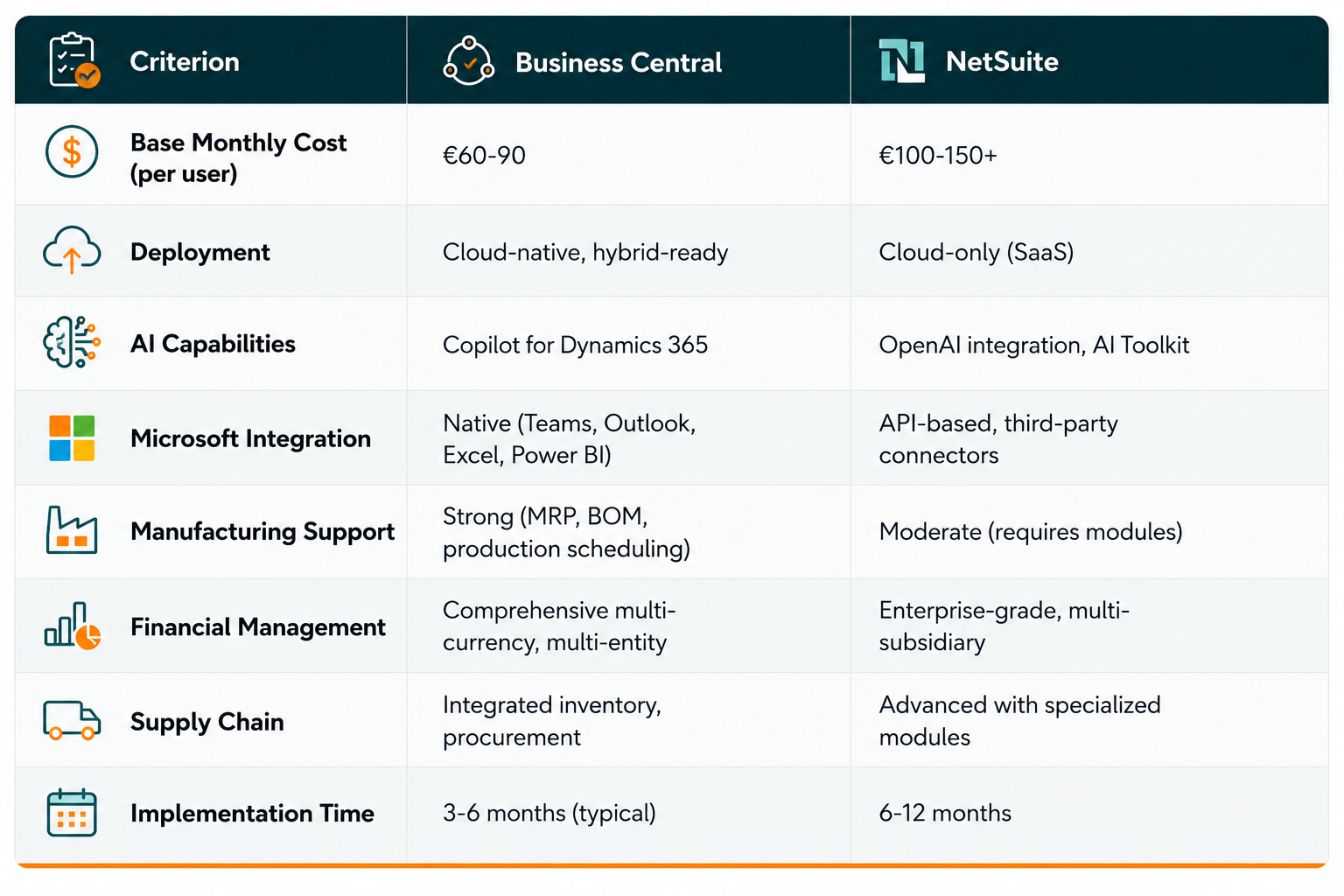
The ERP landscape has evolved significantly. According to Gartner Peer Insights for Cloud ERP, both solutions rank as leaders, but their positioning reflects distinct strategic advantages. Business Central has gained substantial traction among Microsoft-centric organizations, while NetSuite remains the gold standard for companies requiring unlimited scalability and advanced financial consolidation.
"We're seeing a clear bifurcation in the market. Companies already invested in Microsoft 365, Teams, and Power BI are achieving 30-40% faster ROI with Business Central because they eliminate integration complexity. For NetSuite, that advantage comes from its financial consolidation capabilities and independence from any single vendor ecosystem." — **Mareks Polis, ERP Practice Lead at DIGMATIX**
If your organization uses Microsoft 365, this factor alone can justify Business Central:
NetSuite requires connectors and middleware to achieve similar integration, adding cost and complexity.
"One of our manufacturing clients implemented Business Central with 47 users. Their prior ERP required three separate integration platforms and two FTE resources just to maintain data synchronization. With Business Central, Microsoft Power Automate handles 95% of those workflows automatically, and our customer reallocated those resources to innovation projects." — **Mareks Polis, ERP Practice Lead at DIGMATIX**
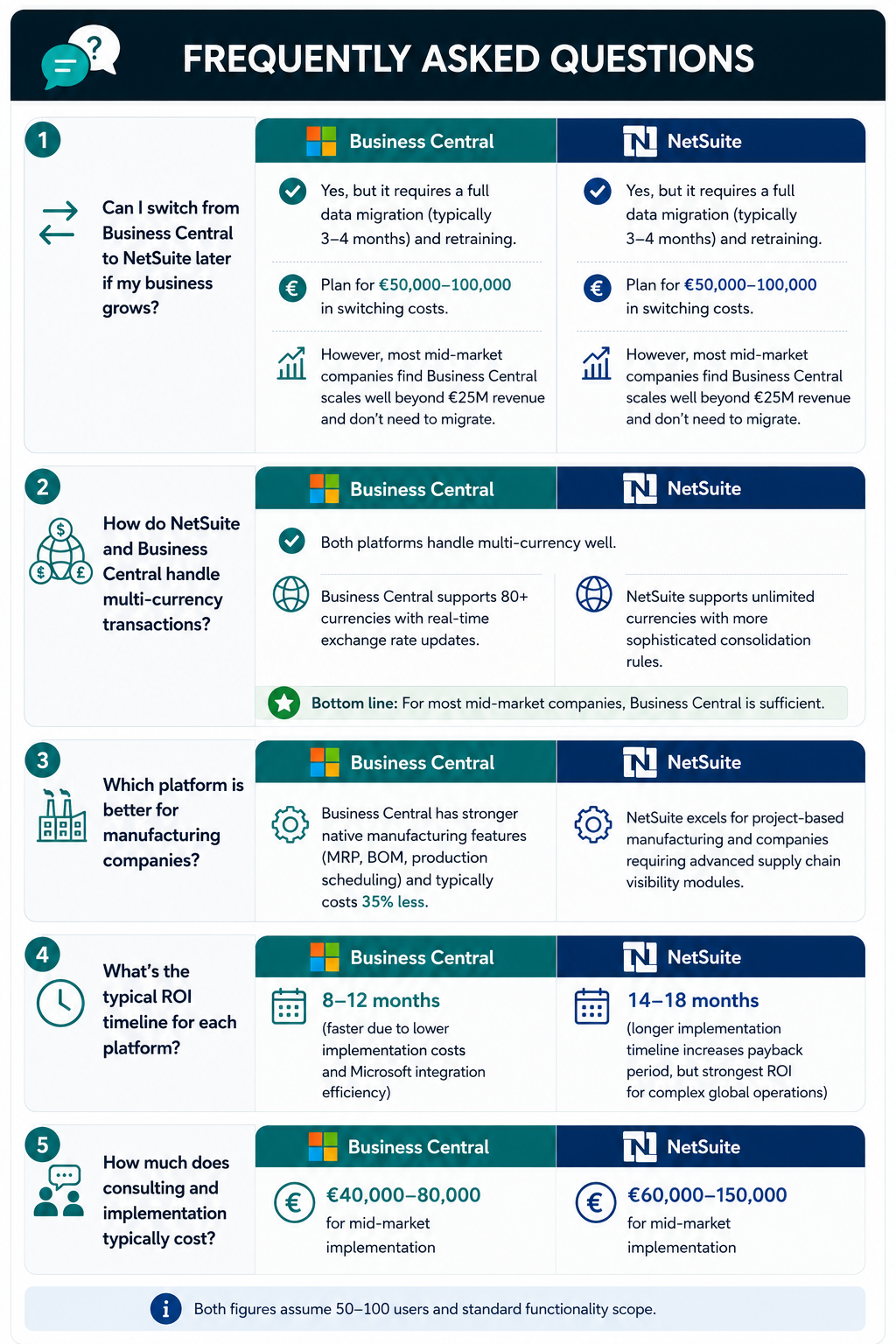
Verdict: For traditional manufacturing (automotive, machinery, consumer goods), Business Central delivers superior value. For project-based manufacturing or companies requiring extreme supply chain transparency, NetSuite may offer more specialized capabilities.
Both platforms excel in financial management but with different strengths:
For mid-market companies, both platforms handle sophisticated financial requirements. NetSuite may offer slight advantages for multinational organizations with complex consolidation rules. Business Central is sufficient for most mid-market financial management needs and integrates seamlessly with Power BI for executive reporting.
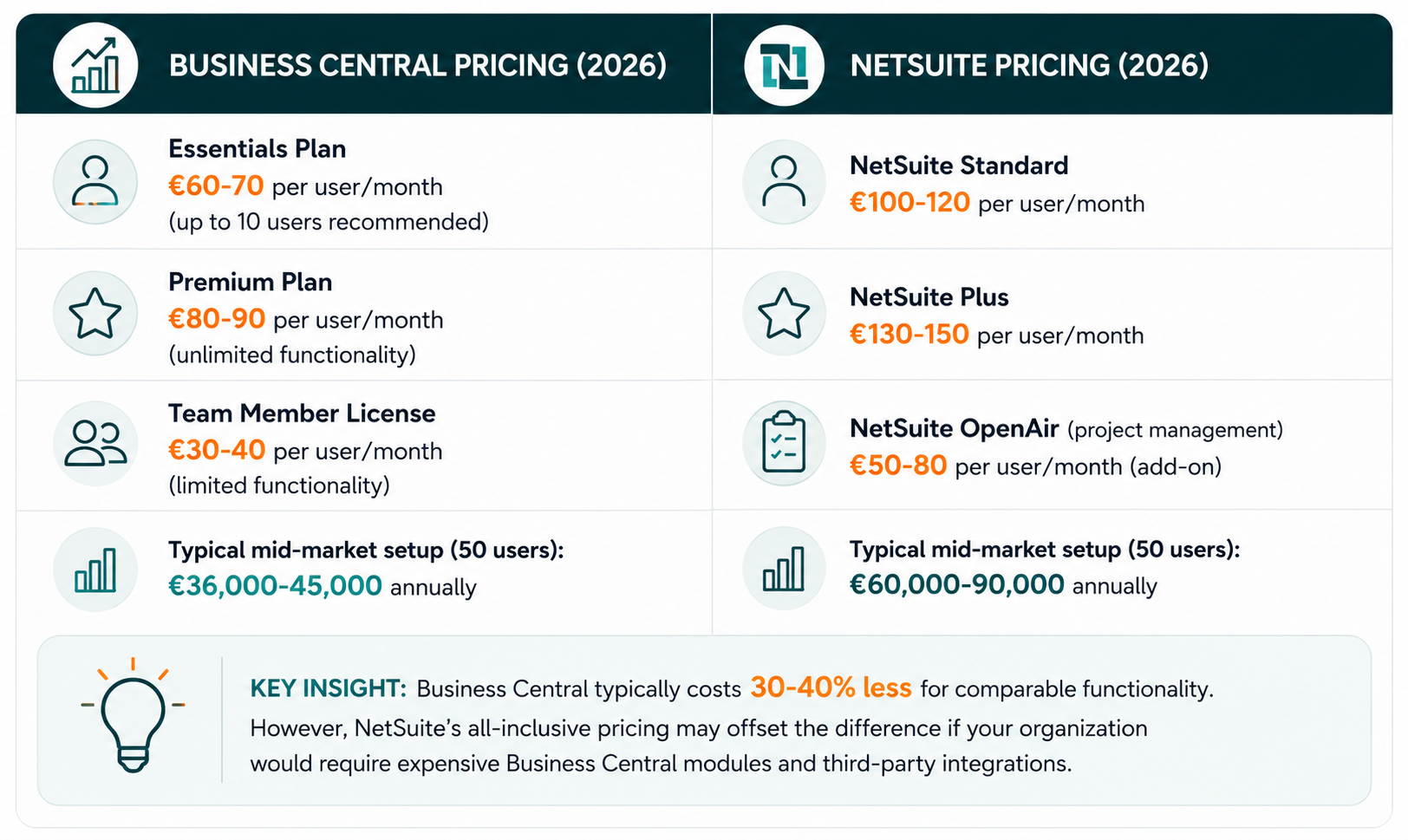
Cost: Included with Premium plan; separate licensing for Copilot features on Essentials
Cost: Additional module licensing required
2026 Perspective: Business Central's Copilot integration is maturing faster due to Microsoft's AI investments. For companies seeking immediate productivity gains through AI, Business Central offers faster time-to-value.
Business Central: Users familiar with Microsoft Office products (Word, Excel, Outlook) find the interface intuitive. Navigation mirrors Office 365 patterns, reducing training time.
NetSuite: Proprietary interface requires dedicated training. Users typically need 2-3 weeks of hands-on training to reach proficiency.
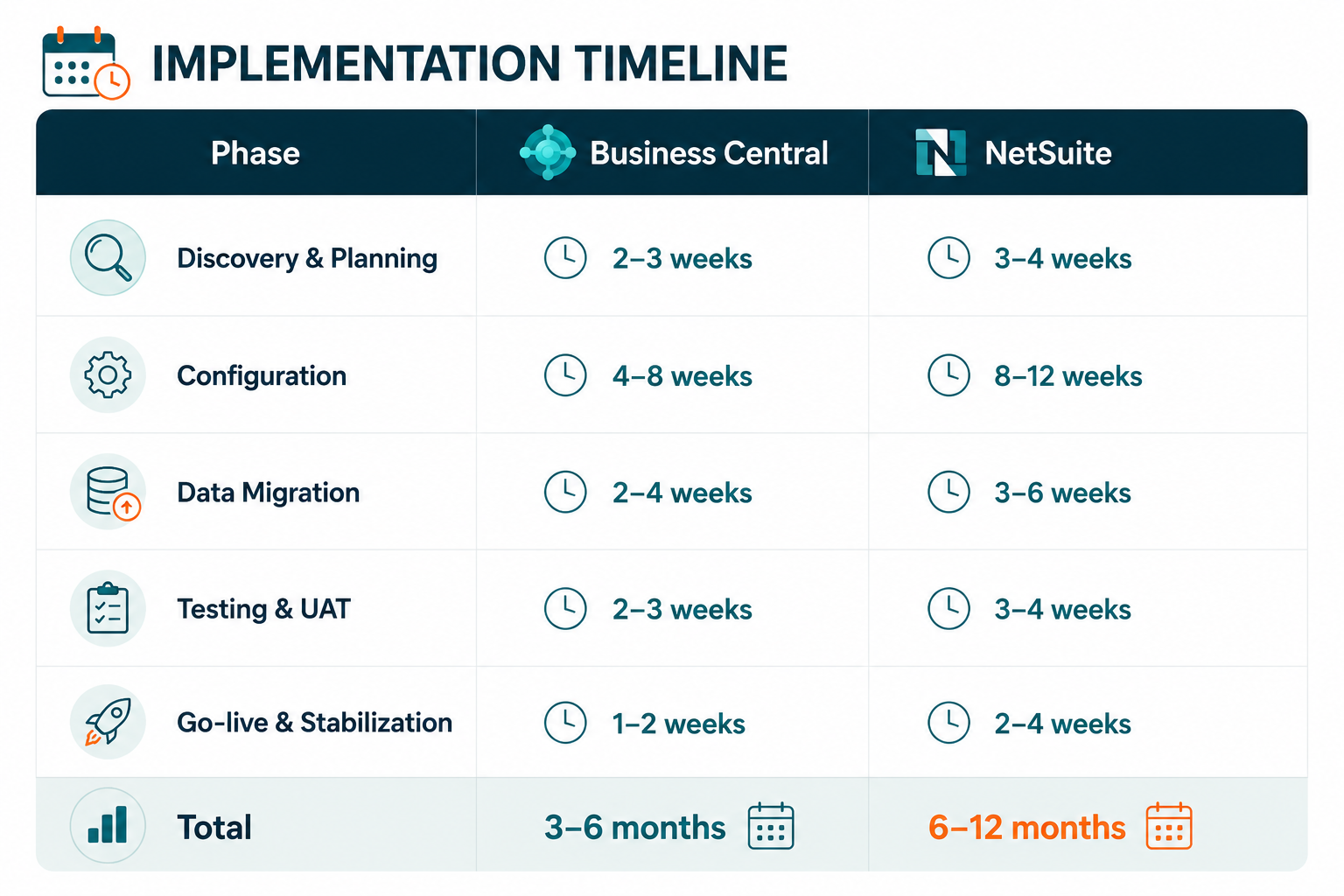
For mid-market companies with primarily Microsoft-using staff, Business Central typically achieves 85-90% adoption rates within 3 months. NetSuite typically requires 4-6 months to reach similar adoption levels.
Choose Business Central if your organization:
Choose NetSuite if your organization:
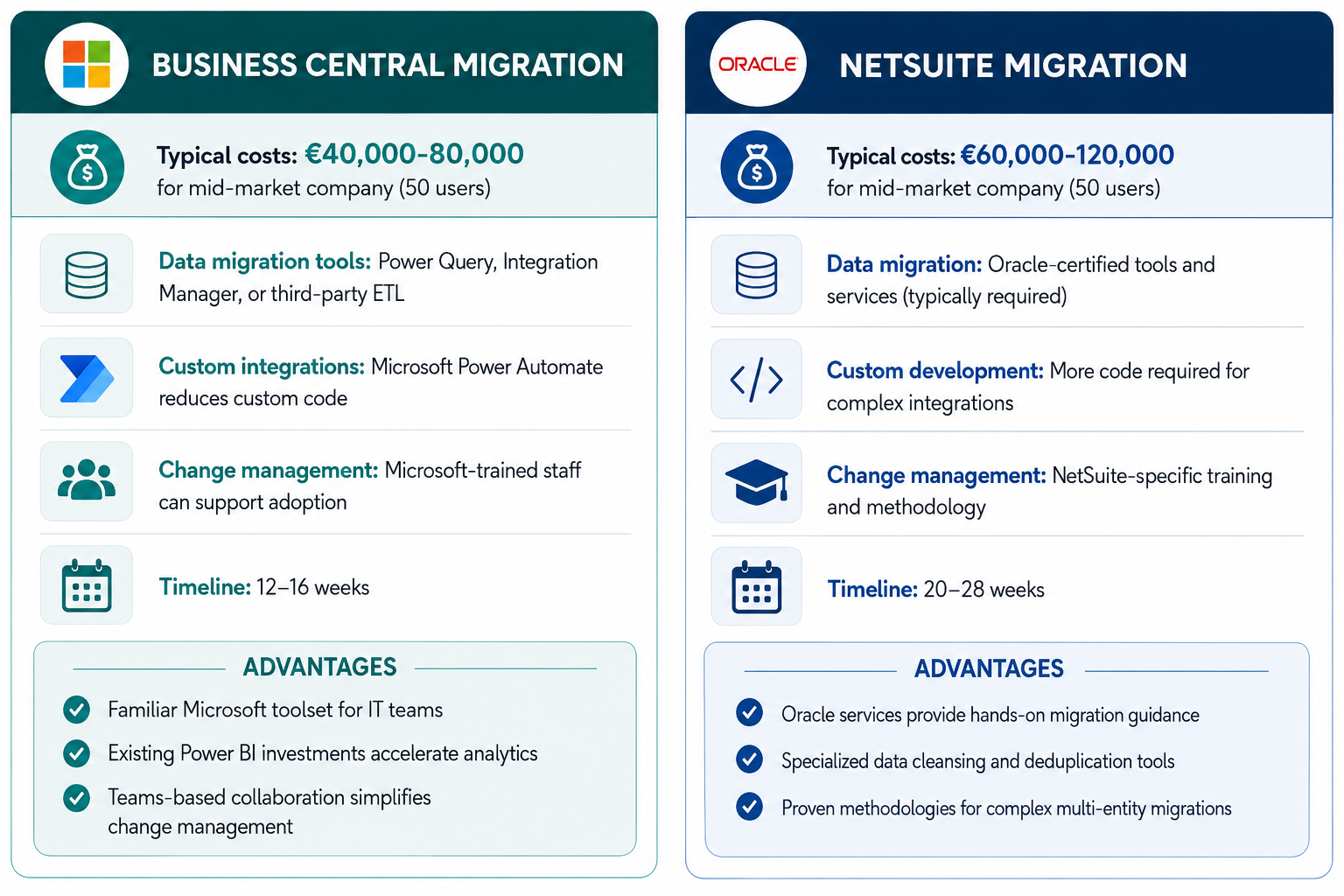
"When evaluating migration costs, most companies overlook the cost of extended implementation timelines. A 3-month delay in going live on a 50-person company costs approximately €75,000 in lost productivity. This reality often tips the scales toward Business Central, which typically delivers faster ROI and shorter payback periods." — **Mareks Polis, ERP Practice Lead at DIGMATIX**
For organizations requiring multiple integrations, Business Central's Power Platform ecosystem offers significant cost advantages.
Recommendation: Business Central
Why: Integrated MRP, lower cost, faster implementation, and Power BI reporting outweigh NetSuite's advantages. Microsoft ecosystem alignment reduces integration costs by 40%.
Timeline: 4 months to full go-live
Investment: €65,000-90,000 total (software, implementation, training)
Recommendation: NetSuite
Why: Complex multi-entity consolidation, OpenAir project management, and advanced financial reporting justify the 6-month implementation and higher cost.
Timeline: 8 months to full go-live
Investment: €120,000-180,000 total
Recommendation: Business Central
Why: Fastest path to mature financial operations, Copilot capabilities support rapid growth, and cost efficiency allows reinvestment in product development.
Timeline: 3 months to basic go-live, 6 months to full functionality
Investment: €50,000-75,000 total
---
---
The choice between Business Central and NetSuite ultimately depends on:
For 2026, Business Central represents the optimal choice for 70% of mid-market manufacturers and mid-sized enterprises operating within Microsoft ecosystems. Its combination of lower cost, faster implementation, superior AI capabilities, and Microsoft integration creates compelling value.
However, if your organization operates globally with complex consolidation requirements or has invested heavily in NetSuite-specific modules, the platform remains an excellent choice despite higher costs.
Ready to evaluate Business Central or NetSuite for your organization? Our ERP specialists at DIGMATIX can help you:
Book a free 30-minute consultation with our ERP Practice Lead to discuss which platform aligns best with your business goals.
---
Ready to transform your financial and operational management? Our Business Central specialists have implemented 150+ successful projects across EMEA. Schedule your free consultation today and discover how we can accelerate your digital transformation.
Would you like to learn more? Let's get in touch.
Sending...