
The growth and competitiveness of a company depend on how accurately and quickly information moves between sales, the warehouse, and the online store. A unified ERP (Enterprise Resource Planning) system provides the foundation for an effective omnichannel business.
A Problem That Needs Solving
Omnichannel sales have brought both opportunities and risks for businesses. Customers expect product availability, pricing, and delivery information to be consistent and up to date across all channels. However, many companies still use separate systems where information moves slowly, or not at all, between platforms. The result is situations where an online store shows products as available when they are not, or conversely, inventory exists in the warehouse but remains invisible to sales channels.
This is not merely an operational issue. Incorrect information reaches customers in seconds, while correcting it can take hours or days. Management ends up making decisions based on incomplete data, forecasting becomes difficult, supply chains fail to operate optimally, and risks increase. A unified view is no longer a convenience, it is essential for survival.
When Systems Don’t Communicate: An Example from Sales and the Supply Chain
Retail provides a good example of how fragmented systems can quickly damage a company’s reputation. A business sells simultaneously through an online store, a physical store, and a B2B channel. The online store launches a campaign for a product that the system shows as having 50 units in stock. In reality, only 10 units remain because a large B2B order reserved most of the inventory the previous day, but the online store has no access to this information. The campaign generates dozens of orders in a short time, which the company cannot fulfill. The result is canceled orders, dissatisfied customers, and reputational damage, the classic situation of “available online, unavailable in the warehouse.”
At the same time, another issue emerges in the company’s supply chain. Supplier orders arrive via email and Excel files, and warehouse staff must manually enter them into the system. Often, products have already been reserved for another customer, but this information does not reach the sales team in time. The result is inaccurate delivery dates, duplicated work, and repeated explanatory calls to partners.
After implementing Microsoft Dynamics 365 Business Central and enabling a real-time supply chain process, the situation changes dramatically. All sales channels use the same inventory data, and Business Central automatically reserves stock the moment an order is entered. The online store sees real-time availability, eliminating overselling. The sales team can see which quantities are reserved or in transit and can plan campaigns based on facts rather than assumptions.
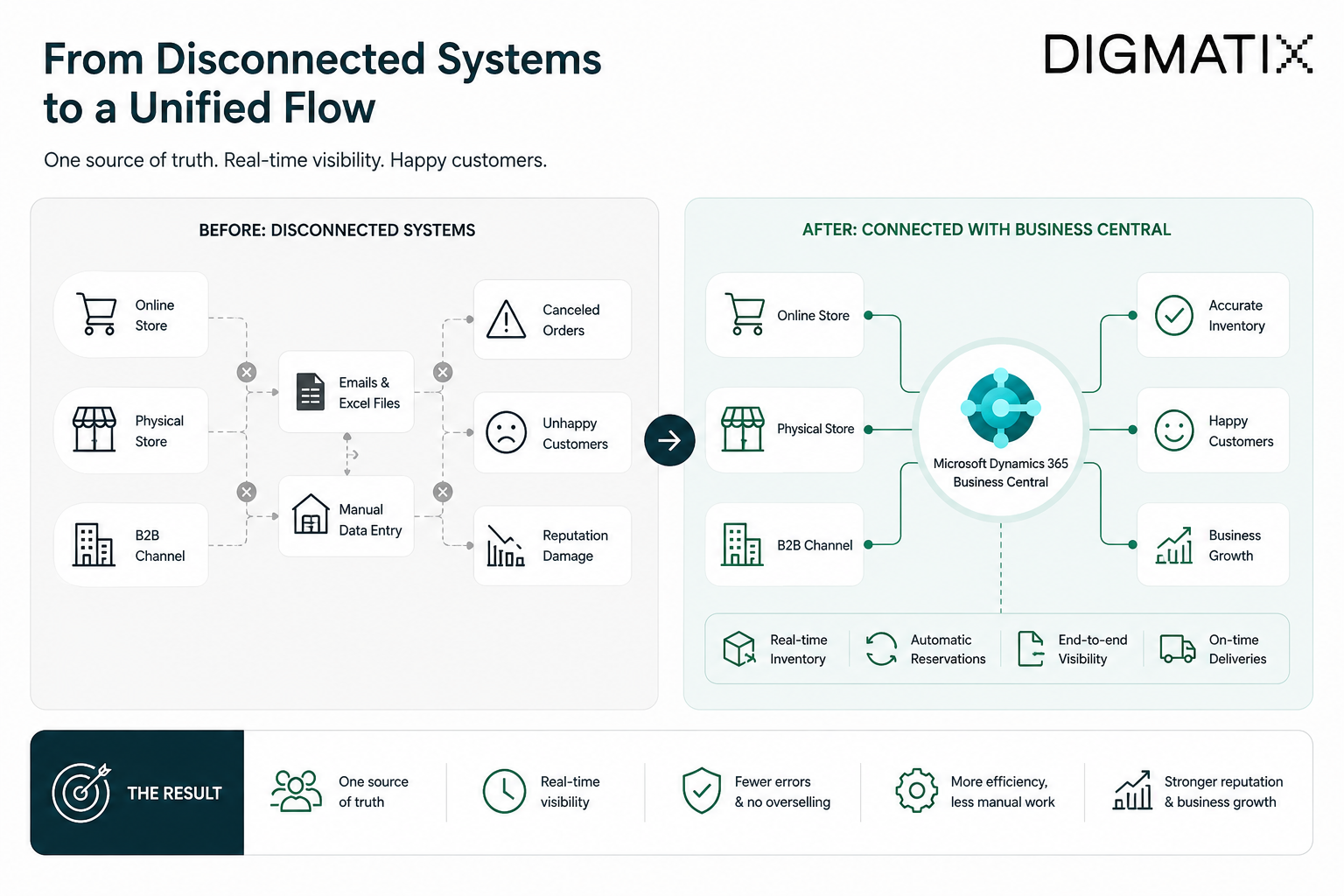
The supply chain also becomes transparent. Business Central automatically updates inventory when goods arrive from suppliers, and the sales team immediately sees which orders can be fulfilled. Orders, delivery notes, and invoices move digitally between partners, without emails, PDFs, or manual data entry. Delivery information reaches partners within seconds, errors decrease, and the same team can handle a larger volume of orders.
The result is a complete, smooth, and reliable sales and supply chain ecosystem where all stakeholders see the same information, allowing the company to focus on growth instead of correcting errors.
What Does Business Central Offer Wholesale Companies?
For wholesale businesses, one of Business Central’s greatest advantages is the integration of sales, warehousing, purchasing, and supply chain operations into a single system where all decisions are based on the same data. Business Central does not focus on just one link in the chain; it covers the entire wholesale cycle, from supplier orders and batch-based inventory management to customer management, pricing, and delivery schedules.
Some examples of useful Business Central features include:
- Management of multiple warehouses, shelves, zones, and locations
- Batch and serial number tracking
- Purchasing and inventory planning
- Flexible pricing, price lists, and campaign management
- Credit limit and payment behavior monitoring
- Electronic document workflows, such as invoices and orders
- Role-based dashboards and KPIs for management
Why Is ERP the Right Choice, and How Does a Unified System Create Strategic Value?
An ERP system is not merely financial or warehouse software, it is a comprehensive business platform that connects sales, warehousing, purchasing, manufacturing, and e-commerce into a single system. Its value lies in its ability to provide a unified and reliable source of data that supports both operational and strategic decision-making.
A unified ERP ensures that all data moves automatically and in real time. This reduces manual work, minimizes the risk of errors, and creates a foundation for process automation. Integrations also play a key role: modern ERP systems communicate seamlessly with e-commerce platforms, logistics and payment solutions, and analytics tools. This enables businesses to expand the number of sales channels without making their systems more complex or unstable.
ERP also supports business growth. When new product groups, markets, or sales channels are added, processes do not need to be rebuilt, the system adapts and can handle increasing volumes of data. This makes ERP not only an operational tool but also an important strategic investment that helps management make more informed decisions, reduce business risks, and ensure sustainable growth.
If you would like to assess how well your sales, warehouse, and online store currently work together, or explore how Business Central could connect various processes into a unified whole, contact us. Together, we can help create a solution tailored to your company’s needs, supporting growth, reducing risks, and providing management with a solid foundation for decision-making.
Source: Business IT Magazine (Äri IT) Spring 2026
Author: Margo Tänavots, ERP Consultant at Digmatix Estonia