
Enterprise Resource Planning implementations are rarely technical failures - they're organizational transformation challenges. The numbers tell a compelling story: ERP projects with excellent change management practices are 6 times more likely to meet their objectives and deliver planned ROI. Yet many organizations treat change management as an afterthought, a secondary workstream assigned to someone between their other responsibilities.
This guide is for C-suite executives, CFOs, HR directors, and project sponsors who understand that technology adoption depends entirely on people. We'll explore the frameworks, strategies, and practical approaches that separate successful ERP transformations from costly, stalled deployments.
Why Change Management Is Your ERP Project's Critical Success Factor
ERP transformations disrupt every department simultaneously. Finance teams adopt new general ledger workflows. Supply chain operations reorganize around integrated demand planning. Sales adjust to consistent customer data architectures. HR manages the communication across all of this while facing legitimate employee anxiety about job changes and skill requirements.
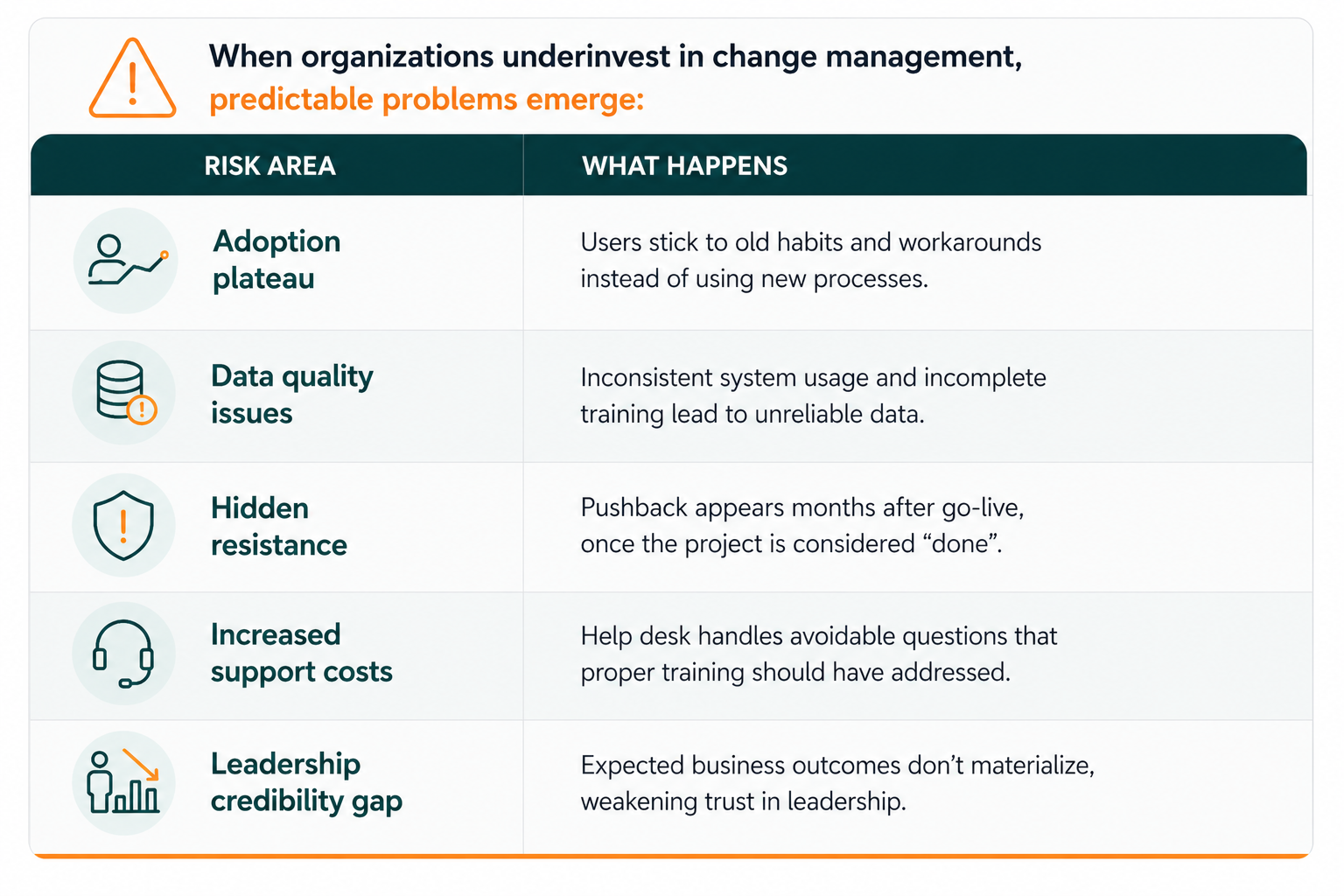
Research from leading consulting firms consistently demonstrates that the projects most likely to exceed expectations share one characteristic: they invested significantly in helping people navigate change, not just in implementing technology.
As Mareks Polis, ERP Practice Lead at DIGMATIX, notes: "We've seen enterprise implementations with identical technical specifications produce vastly different outcomes based entirely on how well the organization prepared its people. Change management isn't a nice-to-have addition to your project budget—it's the primary determinant of whether you realize your investment."
The ADKAR Framework Applied to ERP Implementation
The Prosci ADKAR model provides a structured approach to managing individual and organizational change. Understanding how this applies to your ERP transformation helps you build targeted interventions at each stage.
Awareness is the foundation. Employees need to understand why the organization is implementing this ERP system. What business problems does it solve? How will it improve their work? Organizations that spend 6-8 weeks building awareness before training begins see dramatically higher engagement rates than those that announce go-live dates and launch training immediately.
Desire transforms awareness into genuine commitment. This is where you address the "what's in it for me" question that every employee silently asks. Finance teams need to understand how the new general ledger structure reduces manual reconciliation. Supply chain managers should see how visibility improvements help them meet service levels with less inventory. This stage requires honest conversations about changes to roles and honest support for staff anxious about their capabilities.
Knowledge is the training component that many organizations focus on exclusively. Role-based training that covers actual daily workflows proves dramatically more effective than generic system demonstrations. Hands-on practice using realistic scenarios and real data builds confidence far better than classroom lectures.
Ability is where most organizations discover gaps. Users might understand the concepts in training but struggle when performing real work under time pressure. This is where your go-live support infrastructure becomes critical—not to solve problems for users, but to coach them toward capability. Hypercare periods of 2-4 weeks post-launch, with extended support desk hours and on-site coaches, typically return ROI through faster stabilization.
Reinforcement is where many projects fail due to the premature withdrawal of support. Sustaining behavior changes requires ongoing reinforcement for 6-12 months after go-live. This includes celebrating adoption wins, sharing usage data, continuing targeted coaching for struggling departments, and making process adjustments based on real-world feedback.
Stakeholder Mapping and Communication Planning
Effective stakeholder management begins with an honest assessment of who has influence over adoption in your organization.
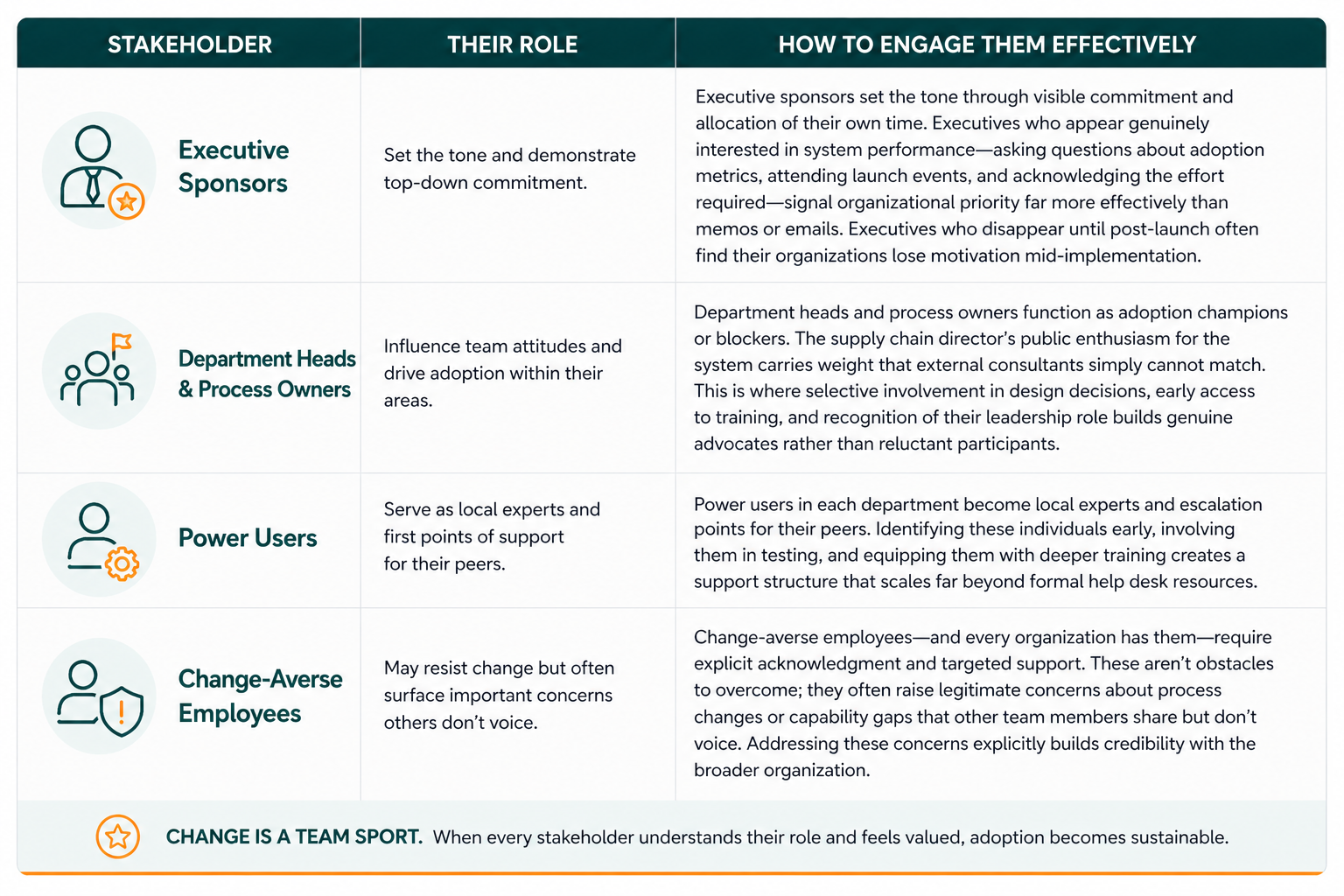
Executive Sponsorship: What It Actually Means Day-to-Day
Executive sponsorship isn't a title—it's an active commitment that requires specific behaviors.
Effective sponsors allocate their own time visibly. This means attending project steering committee meetings, reviewing adoption metrics weekly, and most importantly, participating in launch readiness activities. When department heads see their division president in a system training session or at a launch event, it signals that competence with this system matters for careers in this organization.
Sponsors remove obstacles that impede adoption. When a high-performing director resists attending training because "they don't have time," the sponsor addresses this directly rather than allowing workarounds. When IT delays infrastructure updates needed for system performance, the sponsor escalates to unblock the constraint.
Sponsors communicate consistently about benefits and progress. This doesn't mean generic cheerleading. It means sharing concrete examples: "This month, our order-to-cash cycle shortened by two days because teams are using the new demand planning module effectively." It means acknowledging that transition is difficult while maintaining confidence that the organization will get through it.
Sponsors hold themselves accountable to timeline and budget. If the CFO is explaining delays and cost overruns, middle management notices. If the CFO is transparent about challenges but confident in solutions, that confidence cascades through the organization.
Managing Resistance: It's More Common Than You Think
Resistance to ERP changes takes several forms, each requiring different approaches.
- Technical resistance comes from power users who prefer their current workarounds or aren't convinced new processes are actually improvements. This requires patient demonstration that new processes achieve the same outcomes more efficiently or with better controls. Involving these individuals early in process design and testing often converts skeptics into advocates.
- Capability resistance emerges from legitimate anxiety about competence with new systems or processes. Employees in their final decade before retirement might worry whether they can learn these tools effectively. Addressing this requires honest acknowledgment of the learning curve, extended training windows, and recognition that capability builds over weeks and months, not days.
- Role-based resistance appears when new processes appear to threaten job security or change fundamental aspects of how someone contributes. A purchasing analyst whose entire role centered on exception management might see new automated procurement workflows as threatening. This requires genuine conversation about role evolution—what new responsibilities will emerge as routine work becomes automated?
The most effective resistance management begins with listening. What specifically concerns people? Is it the change itself, doubts about the system, or anxiety about personal capability? Different concerns require different responses.
Building Your Role-Based Training Strategy
Effective ERP training begins with role analysis, not system features. A purchasing manager doesn't need to understand general ledger functionality—they need to understand how to process requisitions, handle approvals, and work with suppliers in the new environment.
- Phased training typically begins 2-4 weeks before go-live, starting with super-users and process owners who can provide feedback and refine training approaches. General training follows closer to launch dates when information remains fresh. Post-launch training continues for 6+ months, addressing specific issues that emerge in production and welcoming new team members.
- Hands-on practice using realistic scenarios and actual organizational data builds confidence far more effectively than lecture-based training. Participants should spend training time performing actual workflows they'll execute in production, ideally using masked production data (actual structure, realistic volumes).
- Reinforcement materials for post-launch reference prove essential. Job aids, quick-start guides, and video tutorials help users troubleshoot issues without escalating to support. Organizations that document these materials during training rather than afterward find adoption moves faster.
- Train-the-trainer models scale knowledge effectively across large organizations. Equipping department leaders and process owners to train their own teams creates local expertise and builds ownership.
Measuring Adoption: KPIs That Matter
Change management success requires metrics beyond project completion or budget variance.
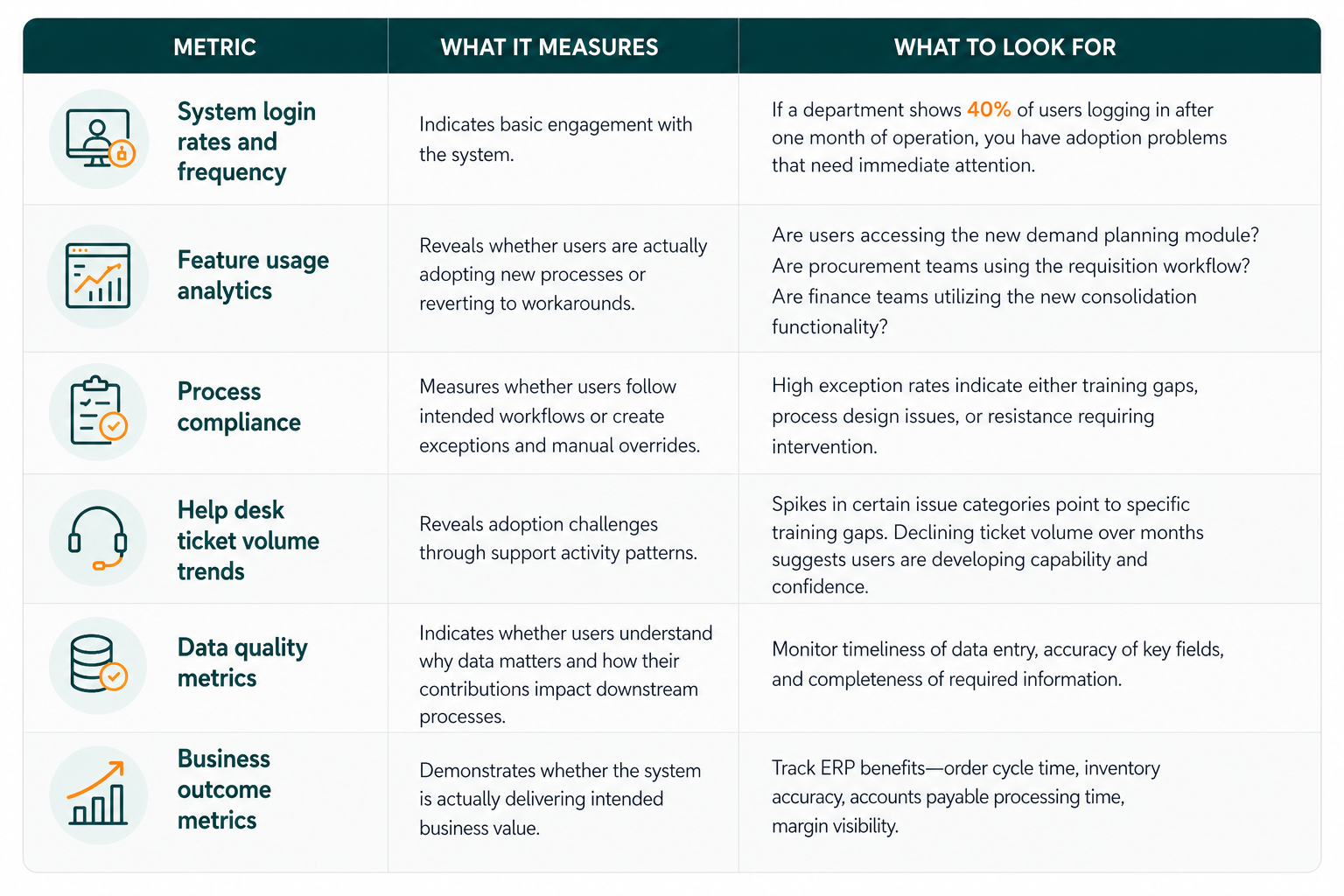
Track these metrics from go-live through 12 months post-launch. Most organizations find adoption curves that accelerate 8-12 weeks after launch as users develop capability through repeated practice.
Common Change Management Mistakes
Organizations often stumble by making predictable errors that experienced practitioners see repeatedly.
Starting change management too late is perhaps the most common mistake. Change management should begin 6-8 months before go-live, establishing awareness and desire before you launch intensive training. Organizations that begin change management when training starts find they're racing against momentum built on an insufficient foundation.
Delegating change management to IT reflects a fundamental misunderstanding. While IT manages technical implementation, change management belongs with business leadership and HR. IT professionals aren't positioned to communicate business benefits, address role changes, or build organizational commitment.
One-size-fits-all training ignores the reality that a procurement director's needs differ fundamentally from a purchasing clerk's needs. Role-based training requires more development effort but delivers adoption rates that generic training cannot match.
Withdrawing support too early causes failures weeks or months after launch. Users developing capability need ongoing reinforcement, coaching, and process refinement based on real-world experience. The first 6-12 months after go-live aren't the "support phase"—they're the critical adoption phase where capability and confidence solidify.
Underestimating the time commitment required from business leaders and process owners leads to insufficient involvement. Effective ERP implementation demands 10-15% of key business leaders' time for 6-9 months. Organizations that don't plan and protect this time find implementation timelines slip significantly.
Budget Allocation: What Change Management Costs
Industry guidance consistently recommends allocating 10-15% of the total ERP project budget to change management and training activities. For a €2 million implementation, this means €200,000-€300,000 dedicated to change management.
This budget covers:
- Change management leadership and resources (€40,000-€60,000)
- Training development and delivery (€80,000-€120,000)
- Communications materials and campaigns (€20,000-€30,000)
- Change coaching and hypercare support (€40,000-€60,000)
- Contingency and reinforcement activities (€20,000-€30,000)
Organizations that underfund change management by trying to absorb these costs within general IT budgets consistently find they must invest these costs anyway—just reactively and more expensively when adoption stalls.
Timeline: When Change Management Begins and Ends
Effective change management spans the entire transformation, not just the implementation phase.
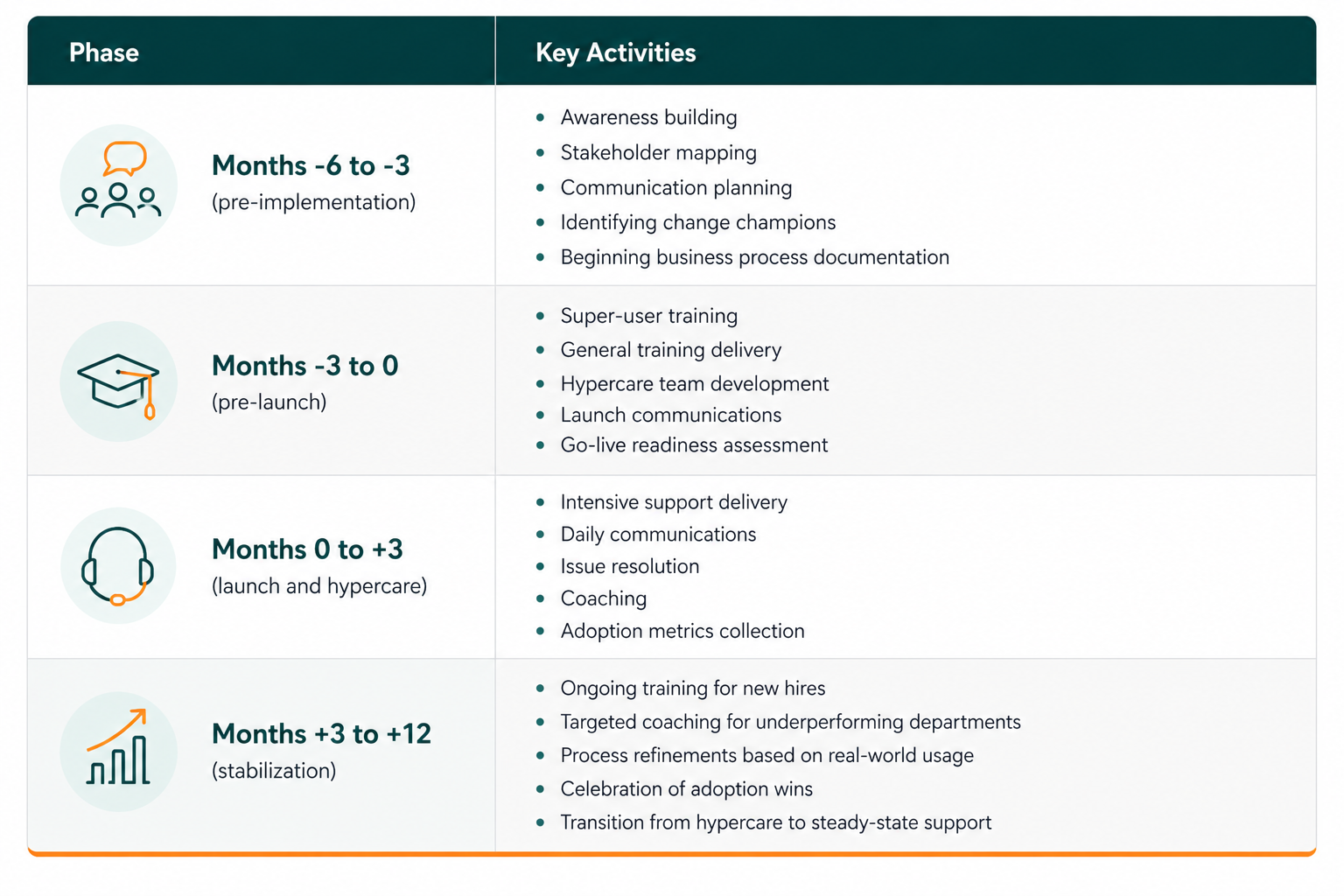
As Mareks Polis notes: "Organizations that treat the 12 months after go-live as critical to success rather than a done-deal often find adoption curves that accelerate rather than plateau. The hardest part of change management isn't launch—it's maintaining momentum and commitment when launch excitement fades."
How DIGMATIX Supports Change Management Success
DIGMATIX brings deep ERP implementation experience across Microsoft Dynamics 365 Finance & Supply Chain, Business Central, and sales transformation initiatives. We've learned that implementation success requires equal investment in technical configuration and organizational change.
Our change management approach combines proven frameworks with practical experience from dozens of transformations. We help leadership define stakeholder strategies, develop role-based training, measure adoption, and sustain behavior change through the critical months following launch.
We work closely with project sponsors and business leaders—not as external advisors, but as partners in translating technical capabilities into organizational capability.
Frequently Asked Questions
Q: When should we begin change management activities?
A: Change management should start 6-8 months before your planned go-live date. This initial period focuses on building awareness about why the organization is implementing ERP, identifying key stakeholders and change champions, and beginning to address misconceptions or concerns. Starting too late creates a compressed timeline where people feel rushed and adoption suffers.
Q: How much of my project budget should we allocate to change management?
A: Industry standards recommend 10-15% of total project budget for change management and training. For a €2 million implementation, this translates to €200,000-€300,000. This includes dedicated change leadership, training development and delivery, communications, coaching, and hypercare support. Organizations that attempt to absorb change management costs within IT budgets typically find they're under-resourcing the most critical success factor.
Q: How do we address resistance from long-tenured employees who prefer existing processes?
A: Resistance from experienced employees usually reflects legitimate concerns about process efficiency or capability development rather than simple obstinance. The most effective approach is listening—understanding specifically what concerns them about the change. Often they've identified genuine process issues that should influence design decisions. Involving them early in design and testing frequently converts skeptics into advocates. For those with capability concerns, acknowledging that learning curves exist and providing extended support builds confidence.
Q: What metrics should we track to measure adoption success?
A: Focus on five key metrics: (1) system login rates by department, (2) feature usage analytics showing whether users are accessing intended functionality, (3) process compliance rates measuring adherence to designed workflows, (4) help desk ticket volume and category trends, and (5) business outcome metrics tied to your ERP benefits (order cycle time, inventory accuracy, accounts payable processing time). Track these monthly from go-live through 12 months post-launch to monitor adoption curves.
Q: What's the most common change management mistake you see?
A: Starting change management too late and delegating it to IT teams rather than maintaining business leadership ownership. Change management is fundamentally about helping an organization navigate business transformation—it belongs with business leaders and HR. It should begin months before training starts, establishing awareness and commitment before intensive training demands. Organizations that defer change management until weeks before launch find they're racing against insufficient foundation and often struggle with adoption for months afterward.
Next Steps: Partner With DIGMATIX on Your ERP Transformation
Your ERP implementation will introduce new technology, but its success depends entirely on how well your organization embraces new ways of working. DIGMATIX brings the change management expertise and deep ERP implementation experience to help your leadership team navigate transformation successfully.
Whether you're beginning strategic planning for an ERP implementation or facing adoption challenges in an active project, our team understands both the technical and organizational dimensions of successful transformation.
Schedule a consultation with our ERP practice team to discuss your specific change management challenges and explore how we can help ensure your ERP investment delivers intended value.
---
DIGMATIX is a Microsoft Solutions Partner for Business Applications specializing in Dynamics 365 Finance & Supply Chain, Business Central, and sales transformation implementations across Northern Europe.